
How to calculate tip-out
Tip-out is calculated one of three ways: a percentage of your tips, a percentage of your sales, or a flat amount per shift. Multiply the base figure by the percentage (as a decimal) to get the amount. On $900 of sales at 2% you owe $18; on $180 of tips at 15% you owe $27. Your net tips are what is left after that amount comes off.
Work out tonight's tip-out
- Find the rule. Ask whether your restaurant tips out on tips or on sales, and the percentage for each position (bar, bussers, runners, host). Many places print it on the closeout.
- Take the base figure. For a percentage of tips, use cash plus card tips. For a percentage of sales, use your total sales, or just bar sales if the bar is tipped out on those.
- Multiply. Base times the percentage as a decimal. 2% is 0.02, 12.5% is 0.125. Add up each position's share if the rule is split by role.
- Subtract from your tips. Cash plus card minus tip-out is your net tips. That is the number to record and the number to divide by hours.
The three tip-out methods, with numbers
Restaurants use one of three structures. The maths is trivial; the trap is mixing up which base figure the percentage applies to.
- Percentage of tips. You earned $180 in tips and tip out 15% to the support pool: 180 × 0.15 = $27. Net tips $153.
- Percentage of sales. You sold $1,400 and tip out 1% to bussers and 1.5% of bar sales ($400) to the bar: 14 + 6 = $20. This is the common structure in full-service US restaurants, and it means a bad-tipping table still costs you.
- Flat amount. $10 to the barback every shift, whatever you made. Simple, and worst on a slow night.
Typical tip-out percentages
There is no law setting the rate, only custom and the house policy. In US full-service restaurants that tip out on sales, the ranges most often quoted by restaurant operators are roughly 0.5% to 1.5% to bussers, 1% to 1.5% of bar sales to the bar (sometimes of all sales), 0.5% to 1% to food runners, and 0.25% to 0.5% to hosts where hosts are included. Places that tip out on tips instead often land between 10% and 25% of tips in total.
In the UK, tip-out as a personal handover is less common because tips increasingly go through a tronc, a pooled scheme run by a troncmaster, and since the Employment (Allocation of Tips) Act 2023 came into force in October 2024 employers must pass on 100% of tips to staff. If you are in a tronc, what matters for your record is your share as paid, not a deduction you make yourself.
Make the deduction automatic
The mistake people make is not the arithmetic; it is forgetting to do it. A tip log that records gross tips overstates what you earn by whatever you tip out, week after week.
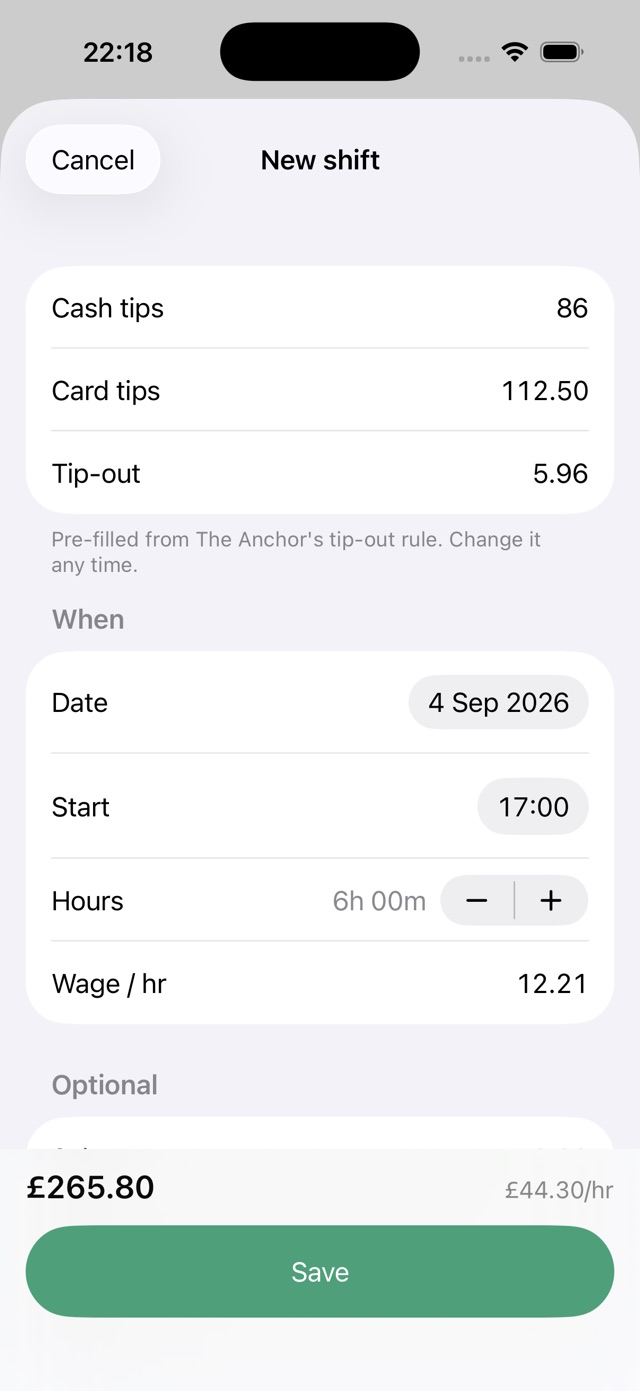
In Tillside the rule lives on the job. Set it to none, a flat amount, a percentage of tips or a percentage of sales, and the tip-out field on every new shift is pre-filled from tonight's tips or sales. If the rule needs sales, the sheet asks for them. On a night that was different, overwrite the number; the app never blocks you from doing that. Net tips, total earnings and your hourly rate all use the resolved amount.
Tip-out and your taxes
In the US, IRS Publication 531 says you report the tips you keep, not the tips you passed on to other employees, so a record of your tip-outs directly lowers the tip income you report. That only works if you wrote the tip-outs down. Our guide to tracking tips for taxes covers what to keep and for how long. This site does not give tax advice; check the current IRS guidance or a tax professional for your situation.
Questions about tip-out
Can my tip-out be more than my tips?
Yes, on a bad night with a sales-based rule. Sell $1,200, get stiffed on tips, and a 2% tip-out is still $24. Tillside allows negative net tips, and if the whole shift ends up below zero the total is shown in red rather than pretending the night broke even.
Is tip-out calculated on cash and card tips together?
Usually, when the rule is a percentage of tips. Some houses only pool card tips because those are the ones they can see. Check your closeout sheet, then set the rule to match.
Related guides

How to keep track of tips as a server
What to write down after every shift, why net tips matter more than gross, and how to make tracking your tips a 30-second habit.
Read the guide
How to calculate your hourly wage with tips
The formula for a server's real hourly rate: wage plus net tips divided by hours, with worked examples and the three mistakes that inflate it.
Read the guide
How to track tips for taxes
The daily tip record the IRS asks tipped workers to keep, how long to keep it, and how to export a clean year of shifts from Tillside.
Read the guide
Do you have to declare tips in the UK?
Tips are taxable in the UK. Which tips go through PAYE or a tronc, which cash tips you must tell HMRC about yourself, and the record that makes it easy.
Read the guideCanonical: https://tillside.co/guides/how-to-calculate-tip-out/