
How to calculate your hourly wage with tips

Your real hourly rate is (wage × hours + tips − tip-out) ÷ hours. A server on $5.00 an hour who works 6 hours and keeps $153 in tips after tip-out earned $183, which is $30.50 an hour. Use hours actually worked and tips after tip-out, or the number will flatter you.
The formula, line by line
Three lines, always in this order. Tillside runs exactly these behind every number in the app.
- Net tips = cash tips + card tips − tip-out
- Total earnings = net tips + (hourly wage × hours)
- Effective hourly rate = total earnings ÷ hours
Worked examples
A US dinner shift. Wage $5.00, 6 hours, $86 cash, $112.50 card, tip-out $5.96. Net tips $192.54. Wage earnings $30.00. Total $222.54, which is $37.09 an hour.
A UK bar shift. Wage £12.21, 8 hours, £30 cash, £45 card through the tronc, no tip-out. Net tips £75. Wage earnings £97.68. Total £172.68, which is £21.59 an hour.
A long double. Wage $5.00, 11 hours, $240 tips, $36 tip-out. Net tips $204. Wage $55. Total $259, which is $23.55 an hour. It was the biggest night of the week in dollars and the worst per hour, which is the point of doing the division.
Three mistakes that inflate the number
- Using gross tips. Forgetting tip-out overstates your tips by whatever you pay out, commonly 10% to 25% of tips at US restaurants that pool.
- Using scheduled hours. You were on the floor from 4:30 until 11:40, not 5 until 11. Use the clock, not the rota.
- Averaging rates instead of totals. A $40/hr four-hour shift and a $20/hr eight-hour shift do not average to $30/hr. Add the earnings (160 + 160) and divide by the hours (12): $26.67. Tillside's week card does it this way, weighting by hours, so the weekly rate matches the rows beneath it.
Why the rate matters more than the total
The total tells you which night was biggest. The rate tells you which night was worth working, which is the question that decides whether to pick up Thursdays or trade them away. Once you have a few weeks of data, sorting by rate usually shows one shift type that quietly pays 30% less per hour than the rest.
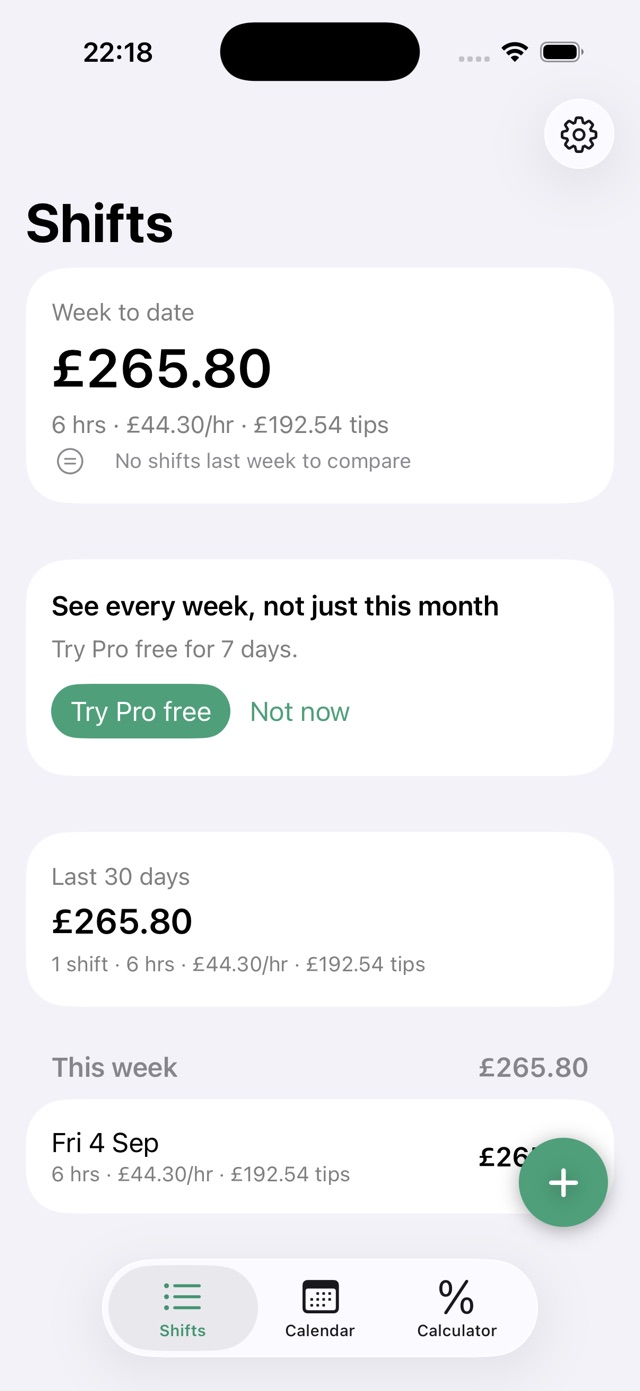
Tillside prints the rate in three places: on the save confirmation as soon as you log the shift, on every row in the list, and on the week-to-date card at the top of the Shifts screen. All three come from the same calculation, so they agree.
A note on tipped minimum wage
In the US, employers using a tip credit must ensure your wage plus tips reaches at least the full minimum wage over each workweek, and must make up any shortfall. Your own record of hours and net tips is the only way to check that they did. Rules differ by state; the Department of Labor's FLSA pages describe the federal baseline.
Questions about hourly rates
Should I include my hourly wage in the rate?
Yes, if you are paid one. The rate is meant to answer what an hour of your time was worth in total. If you want tips alone, divide net tips by hours instead; Tillside shows tips separately on each row so you can do either.
How do I compare a short shift with a long one?
By rate, not by total. Divide each shift's total earnings by its hours. Then, for a week, add all earnings and divide by all hours rather than averaging the two rates.
Related guides

How to calculate tip-out as a server or bartender
Tip-out with worked examples: percentage of tips, percentage of sales and flat amounts, typical rates, and how to make the deduction automatic.
Read the guide
Which shifts make the most money for servers?
Friday and Saturday dinner usually pay most in total, but not always per hour. How to find your own best shifts from three weeks of tip records.
Read the guide
How to keep track of tips as a server
What to write down after every shift, why net tips matter more than gross, and how to make tracking your tips a 30-second habit.
Read the guide
How to track tips from two jobs
Tracking tips across two jobs: separate wages and tip-out rules, comparing hourly rates per job, and keeping one export for tax time.
Read the guideCanonical: https://tillside.co/guides/how-to-calculate-hourly-wage-with-tips/