
How to keep track of tips as a server
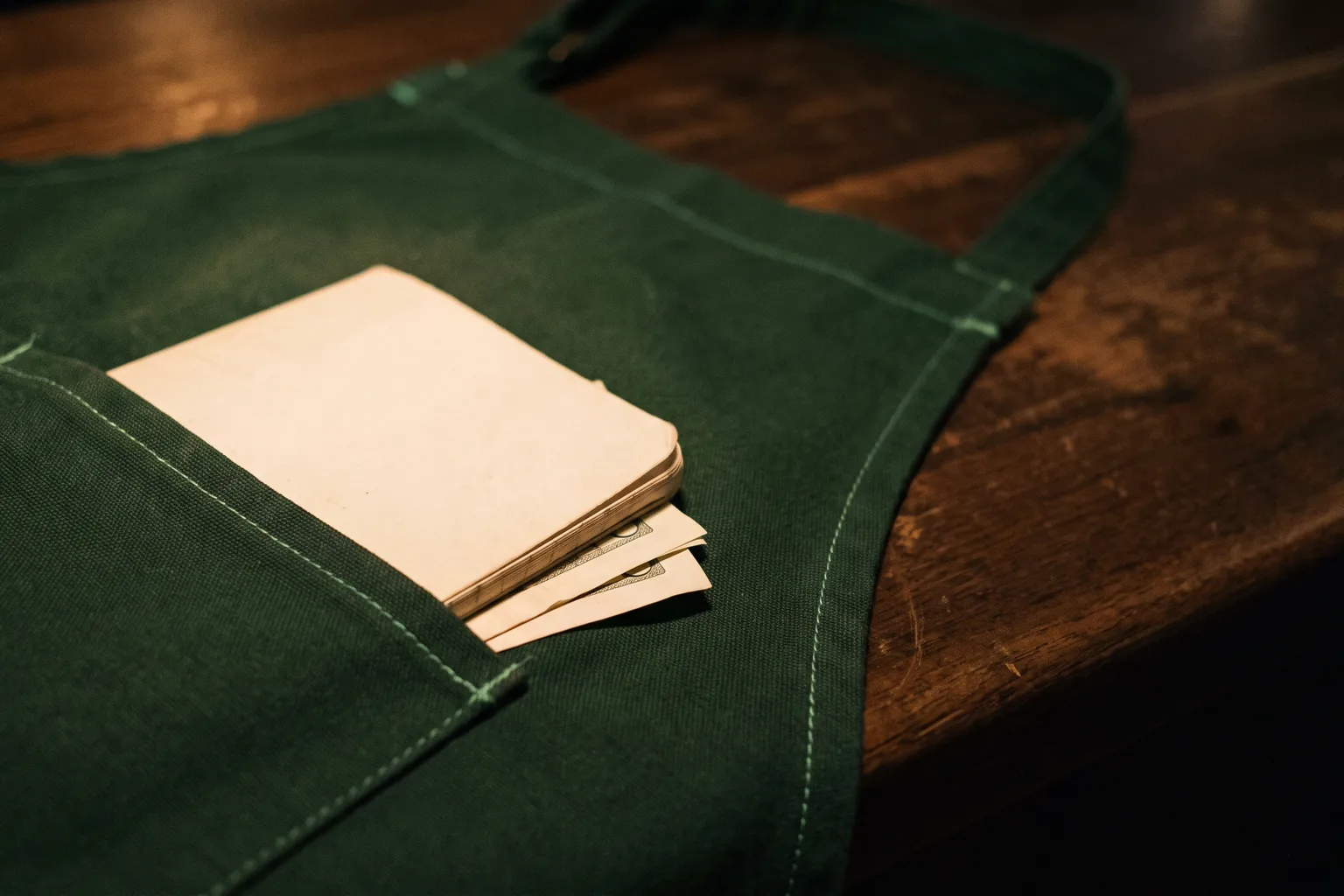
Write down four numbers after every shift: cash tips, card tips, what you tipped out, and the hours you worked. That is enough to know what you really earned, to spot your best nights, and to have a record if anyone ever asks. Everything else is optional.
Track your tips in four steps
- Count before you leave. Count cash tips at the end of the shift, before anything leaves your pocket. Card tips come from the closeout report or your checkout slip.
- Note the tip-out. Write down what you handed to the bar, bussers or runners, or the percentage your restaurant takes. This is the number people forget, and it is the one that makes the difference between what you were told you made and what you took home.
- Record hours and wage. Hours actually worked, not scheduled. If you are paid an hourly wage, note it once per job; it rarely changes.
- Log it the same night. Memory of a Friday close is gone by Sunday. Enter the shift before you sleep, in an app, a spreadsheet or a notebook, and keep doing it.
Why servers lose track of their tips
Pay arrives in three streams that never meet. Wages come on a payslip every two weeks. Card tips are often paid through payroll, sometimes a week or more after the shift. Cash is in your apron, minus whatever you tipped out at the end of the night. Nobody adds those up for you, so the honest answer to "what did I make tonight?" is usually "about" something.
The fix is not a better memory. It is a small, boring record kept the same way every time, with the tip-out included. Most tip trackers on the store treat tip-out as an afterthought, which is why so many servers overestimate what they earn per hour.
What to write down after every shift
The minimum record is four numbers. A few more are worth having if they take no extra effort.
- Cash tips: what you took home in cash, counted before tip-out.
- Card tips: from the closeout, before tip-out.
- Tip-out: what you paid to support staff or into a pool, as an amount.
- Hours: actual hours, including the time you spent doing sidework after your last table.
- Sales (optional): needed only if your tip-out is a percentage of sales, and useful later for seeing your tip percentage.
- Section or notes (optional): "patio", "double", "private party". Six months on, these explain the outliers.
Net tips, not gross tips
Net tips are cash plus card minus tip-out. If you made $180 in tips and tipped out $27, your tips were $153, and that is the figure to track. Gross is the number the restaurant sees; net is the number you spend.
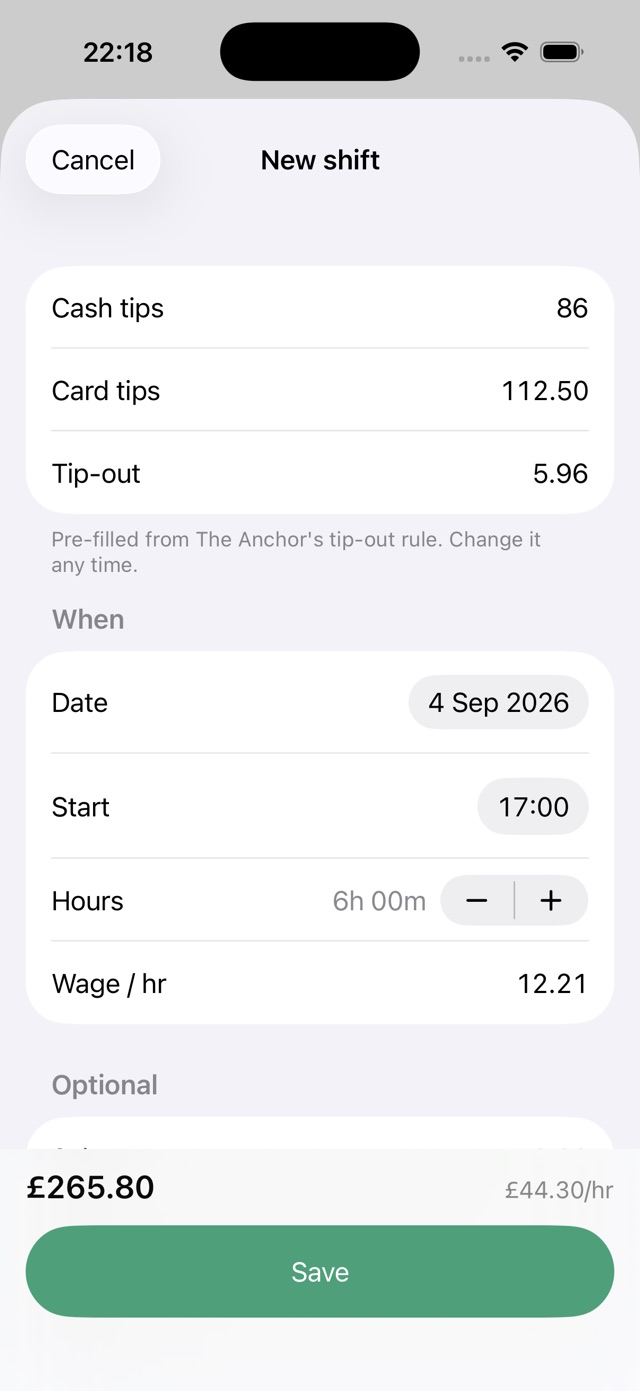
Tillside asks for cash, card and tip-out on the entry sheet and shows net tips on every row. If your job has a tip-out rule (say 3% of tips, or 1.5% of sales), the field is pre-filled and you only change it on a night that was different.
Notebook, spreadsheet or app?
A notebook works and costs nothing, but it cannot add up a week or tell you your hourly rate without a calculator, and it is one spilled drink from gone. A spreadsheet does the maths, but entering a row on your phone at 1 a.m. is slow enough that most people stop after a month. We have a free spreadsheet template if you want to go that way.
An app is the option that survives contact with a double shift, on one condition: it has to be fast. Tillside pre-fills your wage, your usual start time and duration, and your tip-out rule, so a normal night is three numbers and a tap. It also runs the maths every time, so the hourly rate on the save confirmation is the same rate you will see on the week's subtotal.
Make it a habit that survives
Log before you sleep, not the next morning. Keep the entry short so the habit costs nothing. And use a tool that cannot lose the record: the most common one-star review of tip apps is some version of "years of tip history down the drain" after an update or a forced account. Tillside has no account, keeps the data on your phone, mirrors it to your private iCloud, and exports it free whenever you want a copy in your own hands.
After a few weeks the record starts paying you back. The week subtotals on the Shifts screen show whether Thursday is worth picking up, and the effective hourly rate shows whether a long shift actually paid better than a short one.
Questions about tracking tips
Should I track tips before or after tip-out?
Record both. Enter cash and card tips as you received them, and the tip-out as a separate number. Your net tips are the difference, and that is the figure that reflects what you kept. Keeping both lets you see how much tip-out is costing you over a month.
Do I need to track hours as well as tips?
Yes, if you want to compare shifts. Tips alone tell you which night was biggest; tips divided by hours tells you which night was worth working. A $200 six-hour dinner beats a $240 ten-hour double.
Related guides
How to calculate tip-out as a server or bartender
Tip-out with worked examples: percentage of tips, percentage of sales and flat amounts, typical rates, and how to make the deduction automatic.
Read the guide
How to calculate your hourly wage with tips
The formula for a server's real hourly rate: wage plus net tips divided by hours, with worked examples and the three mistakes that inflate it.
Read the guide
Free tip tracker spreadsheet template
A free tip tracking layout for Google Sheets or Excel: the columns, the three formulas, a CSV download, and when a spreadsheet stops being worth it.
Read the guide
Best tip tracker app for servers: how to choose
What to look for in a tip tracker app: tip-out handling, a real hourly rate, no ads, free export, and a backup that does not depend on an account.
Read the guideCanonical: https://tillside.co/guides/how-to-keep-track-of-tips-as-a-server/