
How to track tips for taxes

Keep a daily record of your tips with the date, cash tips, card tips, and what you paid out to other staff, and keep it for at least three years. In the US, tips are taxable income, you must report tips of $20 or more in a month to your employer by the 10th of the following month, and you report the tips you kept rather than the tips you passed on. A record kept nightly makes all of that a five-minute job in April.
What the IRS actually asks tipped workers to keep
IRS Publication 531 asks you to keep a daily tip record showing the date, the cash tips you received, the card tips you received, the tips you paid out to other employees and who you paid them to, and the value of any non-cash tips. The IRS does not require a particular form; a notebook, a spreadsheet or an app all count, as long as the record was kept at the time rather than reconstructed later.
Report tips to your employer monthly when they reach $20 for the month, so they can withhold tax on them. Tips are reported net of tip-outs: money you handed to the bar or bussers is their income, not yours. Employers also allocate tips in some cases; your own record is what you use to show your actual figure if the allocation is wrong.
This page describes record-keeping, not tax advice. Rules change, and recent US legislation added a deduction for qualified tips in certain tax years that depends on having exactly these records. Check the current IRS guidance or a tax professional for your situation.
Why a nightly record beats a year-end estimate
A record kept the same night is credible and complete. A number reconstructed from payslips in April is neither: payslips show card tips that went through payroll and nothing about cash, tip-outs or hours. If your employer's figure and yours disagree, the person with the contemporaneous log is the one who can back their number.
It also protects you the other way. Servers who never logged tip-outs routinely report gross tips because that is the only figure they have, and pay tax on money they gave to the barback.
How to keep the record in Tillside
Every shift you log already contains the fields the IRS lists: date, cash tips, card tips and tip-out, plus hours, wage and job. The tip-out is stored as an amount even when your rule is a percentage, so the record says what you paid, not just the rule.
When you need the year, open Settings and tap Export. Tillside writes a CSV with one row per shift, oldest first, for your entire history, whether or not you pay for Pro. Send it to yourself, your accountant or a spreadsheet through the normal iOS share sheet.
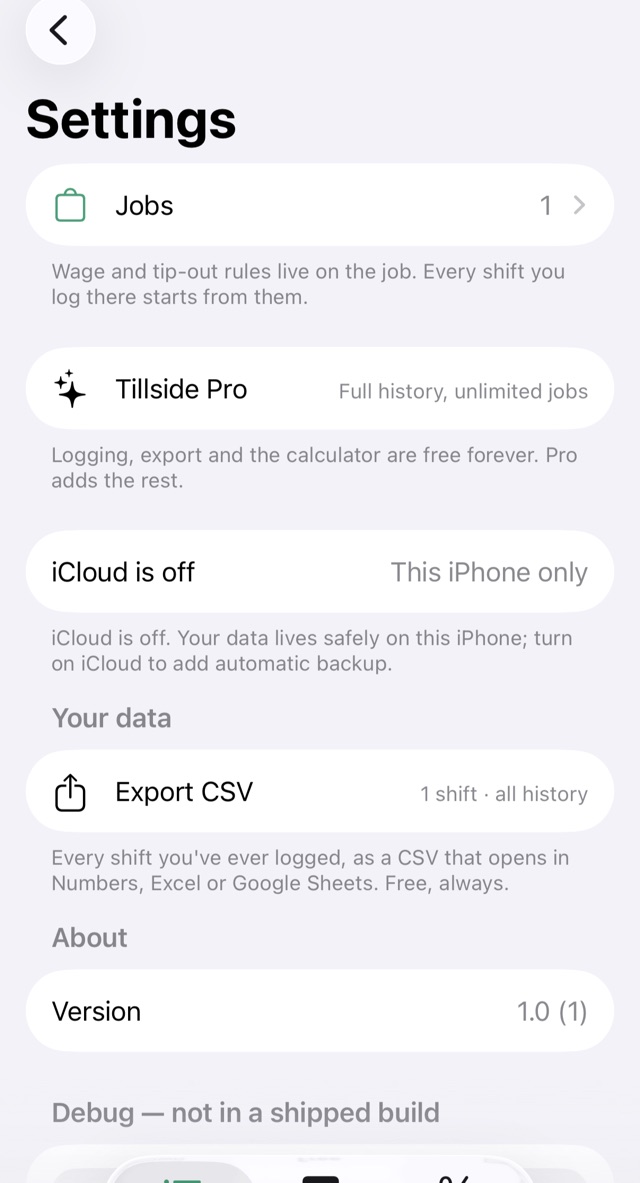
What is in the export
The file opens cleanly in Excel, Numbers and Google Sheets. Columns, in order:
- date, job, start_time, duration_hours
- wage_hourly, cash_tips, card_tips, tip_out
- net_tips, wage_earnings, total_earnings, effective_hourly
- sales, section, note, currency, timezone
Outside the US
United Kingdom. Tips are taxable income. Cash tips given to you directly must be declared to HMRC; tips paid through your employer or a tronc are normally taxed through PAYE. Our UK guide goes through it.
Australia. The ATO treats tips as assessable income to be declared on your return, and expects records to be kept for five years.
Canada. The CRA treats tips as taxable income whether or not they appear on a T4; direct tips must be reported by you.
In every case the record you need is the same one: date, tips, tip-out, hours.
Questions about tip records
How long should I keep tip records?
The IRS generally recommends keeping records that support a return for at least three years from the date you filed. The ATO says five years. Keeping the exported CSV alongside each year's return covers both.
Does the export include shifts older than 30 days on the free tier?
Yes. The 30-day limit applies to what the free tier displays on screen, never to export. Your history is stored in full and the CSV always contains all of it.
Related guides

How to calculate tip-out as a server or bartender
Tip-out with worked examples: percentage of tips, percentage of sales and flat amounts, typical rates, and how to make the deduction automatic.
Read the guide
How to keep track of tips as a server
What to write down after every shift, why net tips matter more than gross, and how to make tracking your tips a 30-second habit.
Read the guide
Do you have to declare tips in the UK?
Tips are taxable in the UK. Which tips go through PAYE or a tronc, which cash tips you must tell HMRC about yourself, and the record that makes it easy.
Read the guide
Free tip tracker spreadsheet template
A free tip tracking layout for Google Sheets or Excel: the columns, the three formulas, a CSV download, and when a spreadsheet stops being worth it.
Read the guideCanonical: https://tillside.co/guides/how-to-track-tips-for-taxes/